MOLLE system for K9: how to place the equipment correctly
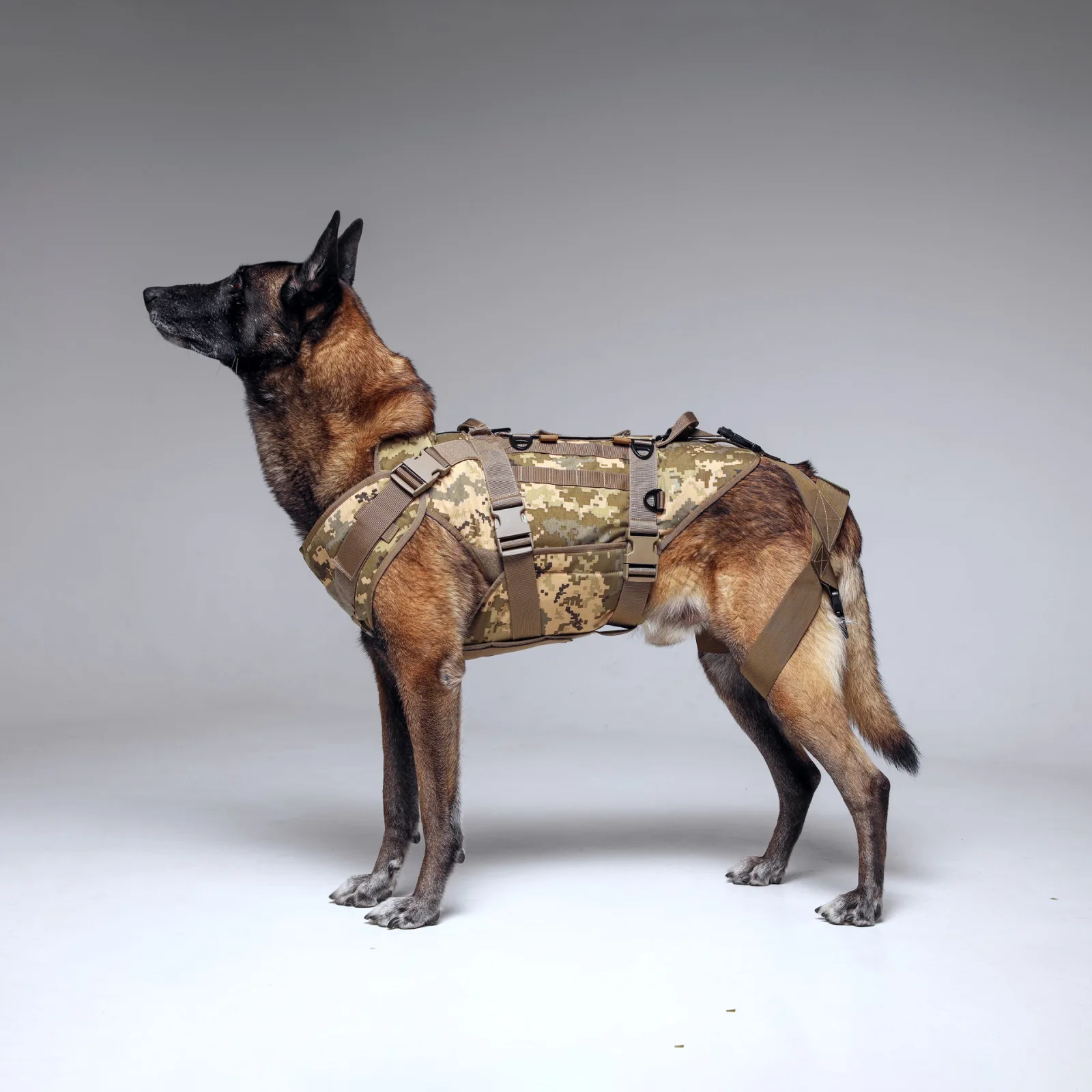
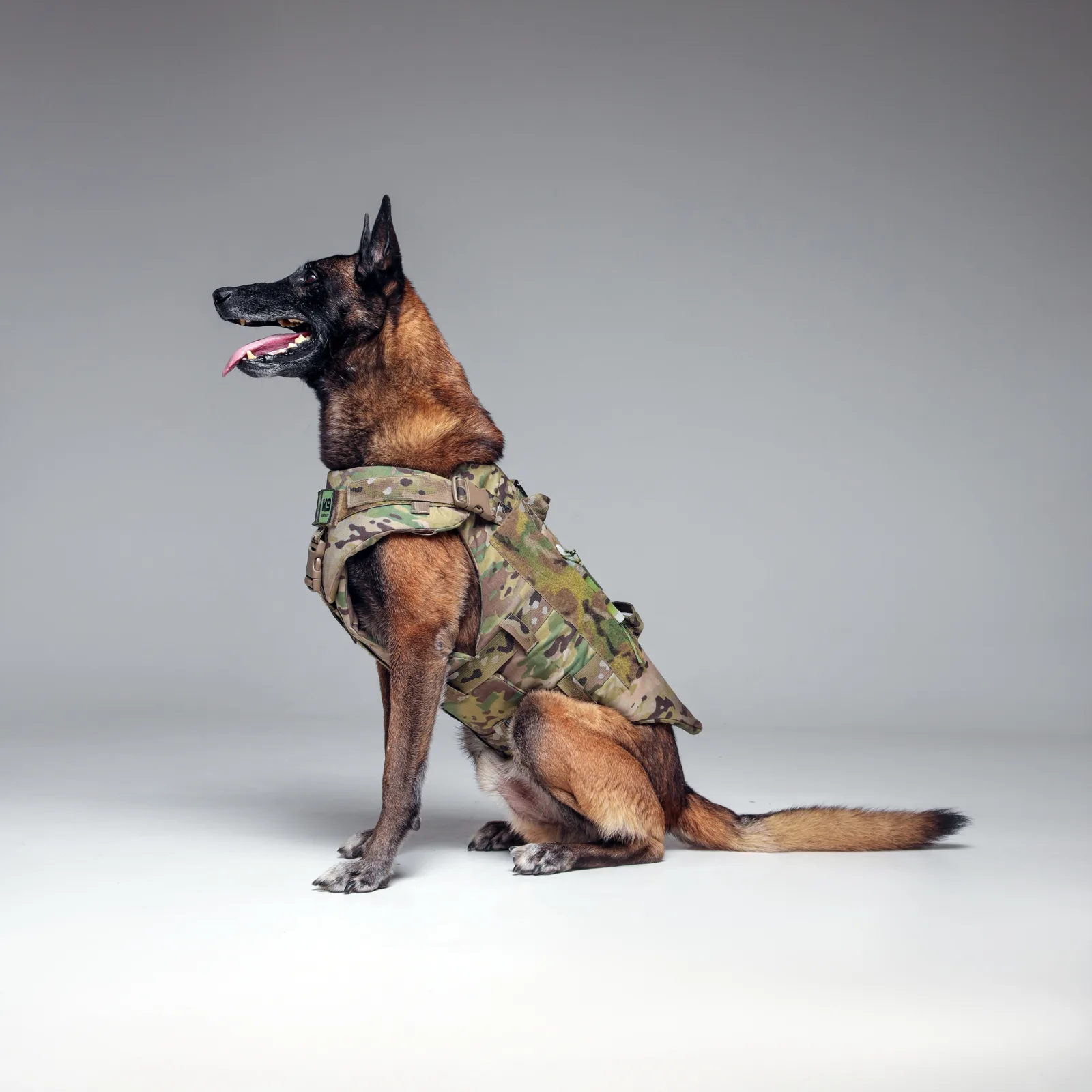
MOLLE (Modular Lightweight Load-carrying Equipment) is a system for attaching gear via rows of strong webbing (PALS), adopted by the US Army in the late 1990s. For a service dog, MOLLE turns a harness or vest into a modular build system: you can attach a first-aid kit, ID patches, a GPS tracker, a flashlight or a water pouch to the sides — and remove them just as fast. The main K9 placement rule is simple: distribute the load symmetrically between the left and right sides, heavier — closer to the center of mass behind the middle ribs, lighter — on the chest and over the pelvis. In Vartoviy K9 gear, MOLLE webbing is on the sides of the tactical harness (6 rows) and the body armor; properly rigged gear doesn't hinder the dog from running, lying down or jumping. Below — exactly how to position the modules, how to weave the webbing, what's forbidden to attach and how much the load should weigh.
What MOLLE is and why it's the standard for K9
MOLLE is not the straps themselves but the logic of modularity. The visible rows of webbing are called PALS (Pouch Attachment Ladder System): sewn-on horizontal loops at about 25 mm spacing, stitched vertically every ~38 mm. Any pouch with the same loops attaches to any panel without sewing or tools.
For a service dog this gives three advantages: gear can be quickly reconfigured for a task, a damaged module replaced in a minute, and only the needed load selected instead of a bulky universal vest. In the Vartoviy K9 tactical harness, 6 MOLLE rows are designed for exactly this flexibility, and the Duraflex hardware and ITW Nexus half-rings hold loads up to 800 kgf.
Principle #1: weight balance between the sides
The first and main principle is symmetry. If the first-aid kit is on the left, the right side should have a module of similar weight (a water pouch, utilities or a GPS in a case). Otherwise the dog will start to "list" to the side while running, and after an hour of work this will overtire the back and neck muscles.
The second principle is distribution along the body length. Heavier items are placed closer to the center of mass, roughly behind the middle ribs, where the spine is strongest. Light items go further — on the chest and over the pelvis. This minimizes the turning moment during sharp turns and jumps.
The third principle is minimalism. Every extra 100 g speeds up fatigue. Take exactly what you'll need on a specific outing and leave the rest on the operator's gear.
Typical placement for a patrol dog
This is a basic, practice-proven layout. Adapt it to your tasks while keeping the side balance.
| Zone | What to attach | Approx. weight |
|---|---|---|
| Left side, front third | ID patch with the dog's name and handler's contact | ~10 g |
| Left side, middle (behind ribs) | Basic first-aid kit | 60–80 g |
| Right side, front third | Unit patch + blood type patch | ~15 g |
| Right side, middle (behind ribs) | GPS tracker in a protective case | 90–110 g |
| Chest / front panel | 3M reflective patch | ~10 g |
| Back, center | Transport handle (standard, not on MOLLE) | — |
Note: the transport (evacuation) handle is a standard element of the harness and vest, not an attachable module. It must stay free and accessible, so don't cover it with pouches.
How to weave the webbing through MOLLE correctly
A typical beginner's mistake is to attach a module through a single loop, after which it dangles and bumps the dog's side. Correct weaving goes in a zigzag, alternating the pouch loops and the panel loops:
- The end of the module's strap goes into the first MOLLE loop of the vest (bottom to top).
- Then — into the corresponding loop of the pouch itself.
- Again through the next loop of the vest.
- Again through the next loop of the pouch — and so on to the end, at least 3 passes.
The tip of the strap must be secured with a snap, hook-and-loop or tucked under a flap. Without securing, the weave comes undone after a week of active work. We covered attaching pouches in more detail in the article on MOLLE on the tactical harness.
Attaching the first-aid kit: on the dog or the handler
In combat and search work, the tactical first-aid kit is usually attached to the dog itself, not the operator. The logic is simple: if the dog breaks away from the handler or is injured far from them, the medical supplies must be next to the wound. Attachment is done via two MOLLE straps plus an extra paracord safety loop.
For patrol and training work it's acceptable to keep the kit on the handler's gear — that makes it easier to control the weight on the dog. What exactly should be inside we covered in the guide on a K9 first-aid kit, and a ready set is in the Vartoviy K9 tactical first-aid kit.
MOLLE on body armor: separate logic
Vartoviy K9 body armor also has MOLLE webbing on the sides and hook-and-loop for patches, but it should be loaded moderately. The ballistic panel (UHMWPE to DSTU 8782:2018, Class 1) must sit tightly against the body, so excess load that pulls the panel away reduces the effectiveness of protection and shifts the vest during movement.
On body armor it's sensible to keep only light items: ID patches, a blood type patch, reflective markers. The kit, GPS and bulky pouches are better moved to the operator or to a separate tactical harness if the dog wears it over. The vest also has two carry handles and D-rings — these are used for evacuation, so keep these points free.
What you must NOT attach to the dog
- Large knives and hatchets — injure the dog when flipping over or falling.
- Carabiners without a guard flap — get stuck in grilles, fences, branches.
- Glass ampoules in open pockets — break on impact.
- Magazines with rounds — dangerous if the casing is damaged.
- Any pyrotechnics (smoke, flash-bang means) — strictly forbidden, even "training" ones.
- Power banks and batteries — heating and risk of a chemical reaction on impact.
The general rule for a dog's load: minimum metal and glass, maximum light polymers and nylon, no sharp edges without a sheath.
Check after setup
Configuring MOLLE for a specific dog is 30–40 minutes of work. After each layout change, run a short test:
- The dog lies down and gets up freely without modules catching.
- A 200 m run without losing speed or listing to the side.
- A jump over an obstacle — nothing bumps the sides or dangles.
- After removing the gear — no abrasions or pressure marks on the body.
If something interferes — re-weave the webbing or redistribute the weight. Properly assembled gear the dog "doesn't notice." Regular care of the load and panels extends service life: there's a separate article on caring for tactical gear.
FAQ
How many modules can be attached to a dog vest's MOLLE?
Not by count, but by weight. For a 25–35 kg dog, aim for a total load up to 300–400 g, evenly distributed across the sides. Symmetry and placement behind the center of mass matter more than the number of pouches.
Can the first-aid kit be attached to body armor via MOLLE?
Technically yes — the webbing on the sides of the body armor allows it. But bulky pouches pull the ballistic panel away from the body, so the kit is better moved to the tactical harness or the handler, leaving only light patches on the body armor.
How do I secure the MOLLE webbing so the module doesn't dangle?
Weave in a zigzag through at least 3 loops, alternating pouch and panel loops, and secure the strap tip with a snap, hook-and-loop or tuck it under a flap. Attaching through a single loop always leaves play.
Which side for which gear should I choose?
There's no fundamental difference between the sides — balance matters. Lay it out so the left and right sides are equal in weight, and the heaviest module ends up behind the middle ribs.
Does Vartoviy K9 body armor have an NIJ IIIA certificate?
No. NIJ is a US standard often cited for comparison. Our body armor is certified to the Ukrainian standard DSTU 8782:2018 (Class 1): it stops 9×18 mm PM/APS and 9×19 mm Luger bullets and has anti-fragment protection to STANAG 2920.
Where to buy modular MOLLE gear for a dog?
In the catalog of Vartoviy K9 tactical gear: a tactical harness with 6 MOLLE rows, a tactical vest and body armor. All products are sewn by a Ukrainian manufacturer, delivery across Ukraine is free by Nova Poshta.