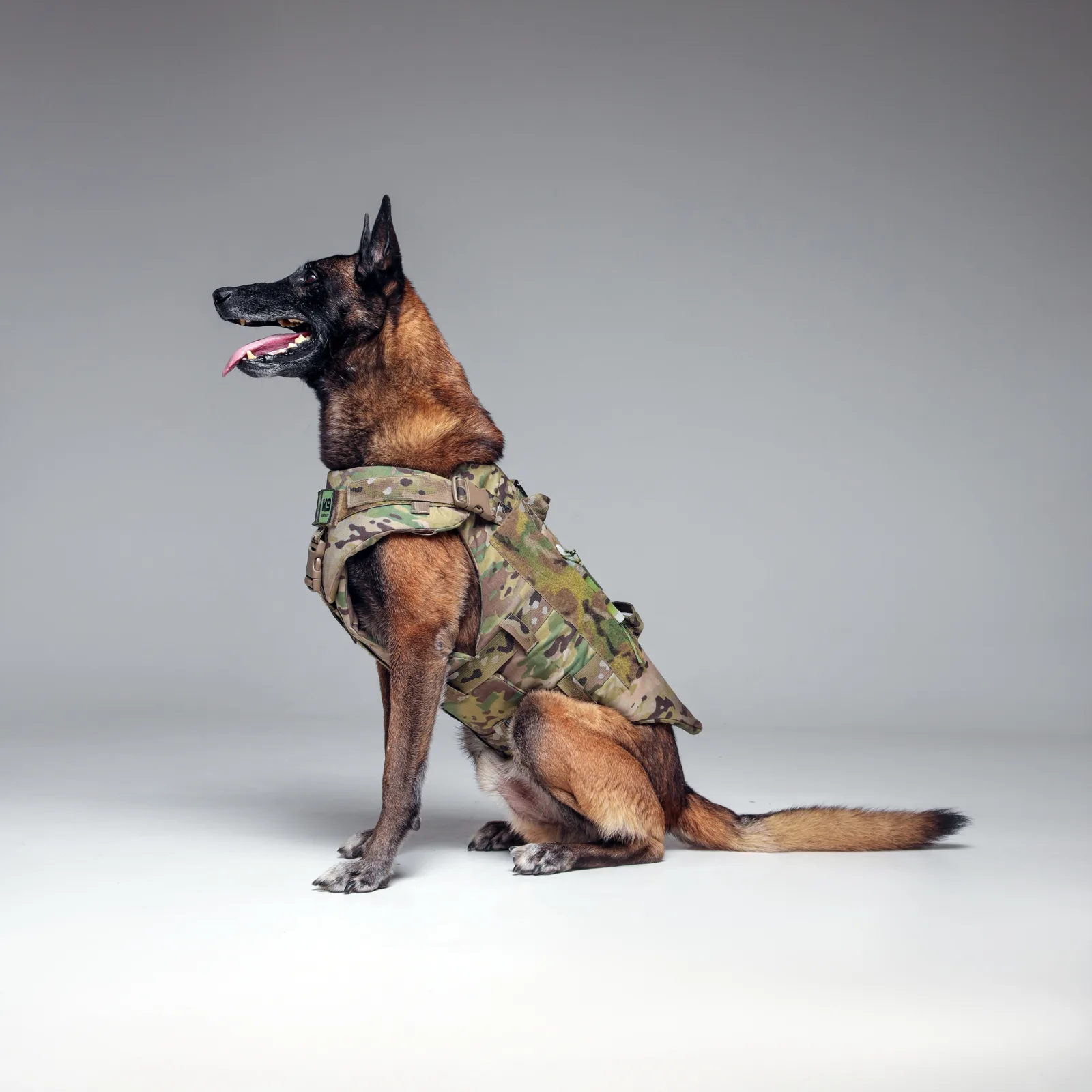
Camouflage vs. signal color: which body armor to choose
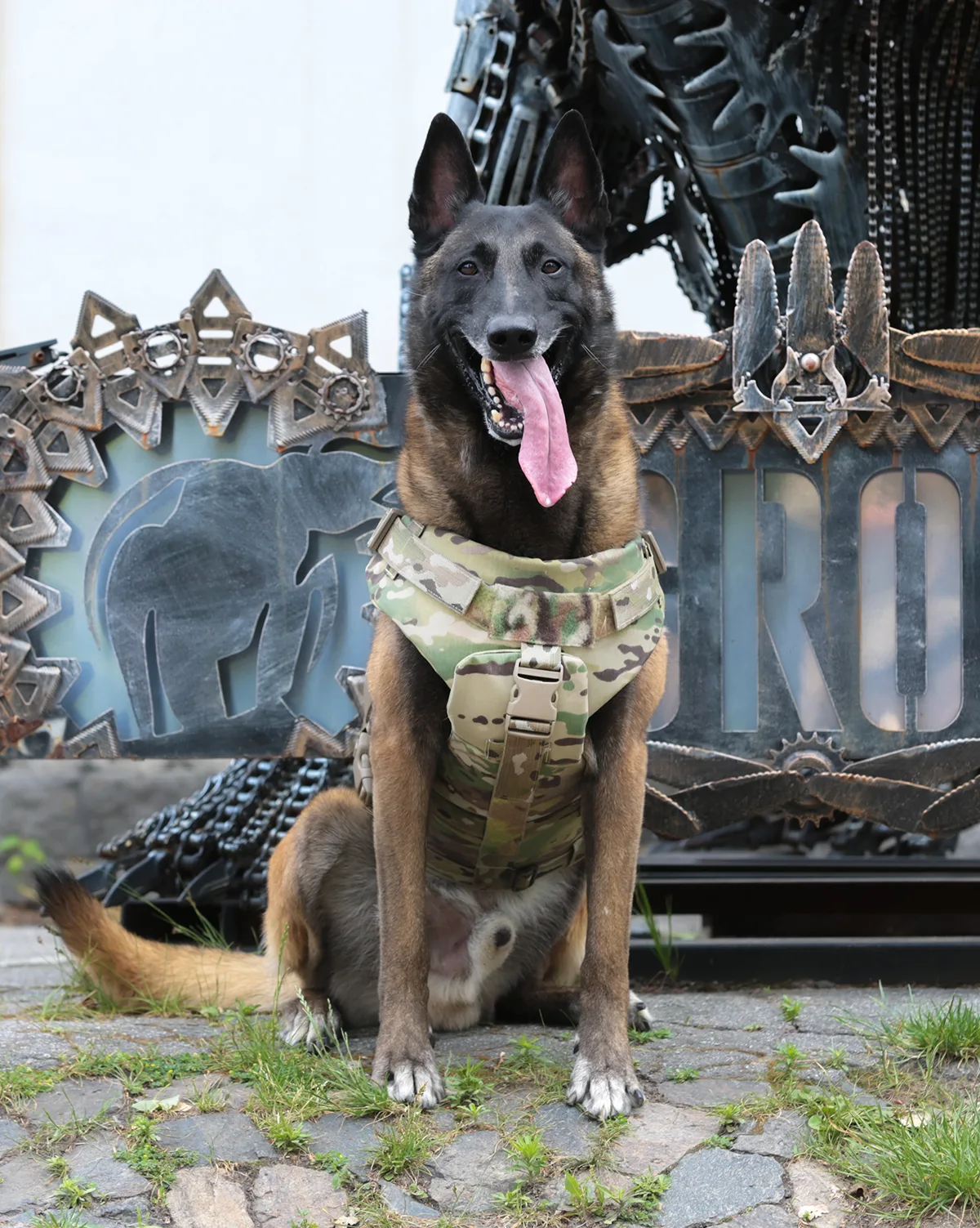
A service dog's gear color is a tactical decision, not a matter of taste. Camouflage (multicam, coyote, olive) is chosen when the dog must stay unseen: assault, reconnaissance, patrol in the "green zone." Signal colors (SAR orange, fluorescent yellow-green) are chosen when visibility matters more: search and rescue, work near vehicles, joint operations of several units. The universal rule: one main item in a tactical color (multicam or coyote work in ~80% of conditions) plus removable signal elements — an orange ID patch, 3M reflective tape, an IFF marker. Vartoviy K9 body armor is sewn to the dog's size by measurements, the outer layer is Cordura 500D, and the side panels have MOLLE and hook-and-loop for patches, so the color configuration is easy to change for the scenario without buying a new item. Below we break down which color suits which task and how to combine concealment with visibility.
Camouflage: when the dog must be "invisible"
Camouflage colors break up the dog's silhouette against the terrain and reduce the risk of detection during assault, reconnaissance and patrol. For the Cordura 500D outer layer on our items, classic army patterns are available.
- MultiCam: the most universal pattern — forest, city, plains, all seasons. Adopted by the US Army in 2010, widely used in the Ukrainian Armed Forces.
- Coyote Brown: dry climate, steppe, southern and central Ukraine. Blends well with sun-burnt grass and soil.
- Olive Drab: forest and forest-steppe, northern and western regions in the warm season.
- Ranger Green: dense forest, mountain conditions, wet foliage.
- Black: appropriate only at night or in urban areas; by day, black contrasts with most natural backgrounds and gives the dog away.
If you're still choosing the main item, start with materials and design — covered in the complete 2026 body-armor buyer's guide — and only then pick a pattern for your region of work.
Signal colors: when visibility matters more than concealment
Signal colors are used where, conversely, the dog must be found quickly by eye — in search-and-rescue, medical and road scenarios, and to avoid "friendly" fire.
- SAR orange: search and rescue in the mountains, forest, on water. It's the base color of our rescue harness, where hydrophobic Cordura 500D in SAR orange is paired with 3M reflective (visibility up to 80 m in headlights).
- Fluorescent yellow-green: work on roads, near vehicles, at dusk — best "read" by human peripheral vision.
- Red: marking of K9 medical staff and veterinary teams.
A signal color only works paired with a reflector. By day a bright color is visible, but in the dark without 3M reflective tape the dog "disappears" again — that's why these two elements are always together on rescue gear.
Colors for identification (IFF)
In joint operations of several units, the dog often gets a bright marker over a camouflage item — so allies don't mistake it for a threat. This is a separate logic, different from concealment.
- Orange ID patch: the signal "friendly K9, hold fire." Attached by hook-and-loop, removed instantly.
- Red cross on a light field: a medical K9 working with the wounded.
- Infrared (IR/IFF) marker: visible only in night-vision devices, doesn't give the dog away by day.
All these elements attach via hook-and-loop and MOLLE on the body armor's side panels. More about patches, handles and mounts — in the article on tactical accessories for body armor.
Camouflage vs signal: a quick comparison
| Criterion | Camouflage | Signal color |
|---|---|---|
| Main goal | Not to be noticed | To be found quickly |
| Typical scenarios | Assault, reconnaissance, patrol | Search-rescue, roads, medevac |
| Colors | MultiCam, coyote, olive, ranger green | SAR orange, fluo yellow-green, red |
| 3M reflective | Usually no (gives away position) | Mandatory |
| At night | Black / IR marker | Reflective tape + fluo |
How to choose for your conditions: 4 steps
- Work location. Forest, steppe, city or mountains — this sets the base pattern (olive/multicam for forest, coyote for steppe).
- Time of day. Day only, night only or both — this decides whether an IR marker and reflective tape are needed.
- Nature of the task. To hide (assault, searching for the enemy) or to be visible (rescue, guarding, roads).
- Combination. Take a main item in a tactical color and add 1–2 removable signal patches for mixed operations.
The universal solution
If the budget is for one item, choose multicam or coyote: they cover about 80% of conditions. Supplement with removable hook-and-loop signal patches and, if needed, reflective tape. This way the same dog camouflages on a mission in the morning and gets an orange ID marker in the evening for work near vehicles or in a joint patrol.
Avoid "trendy" colors — neon green, acid pink, purple. They don't camouflage, are not a recognized signaling standard and only disorient operators of other units. If your work is mostly rescue, it's better to take a specialized SAR item right away — like the rescue harness in orange with 3M — than to try to "repaint" a combat kit.
FAQ
Which dog body armor color is universal?
MultiCam or coyote. MultiCam works in forest, city and plains in all seasons, coyote — in steppe and dry climate. One of these patterns covers about 80% of scenarios; the rest are handled with removable signal patches.
Can a signal color be added to a camouflage vest?
Yes. The side panels of Vartoviy K9 body armor have MOLLE and hook-and-loop for patches, so an orange ID patch, a medical marker or an IR element attach over the camouflage and remove instantly. This is more flexible and cheaper than buying a separate bright item.
Why is the rescue harness specifically orange?
SAR orange is most visible against forest, snow and water and is the international color of search-and-rescue services. Paired with 3M reflective, it gives dog visibility up to 80 meters in headlights — critical during night searches.
Does reflective tape give the dog away by day?
By day, ordinary reflective tape barely glints without a direct light source, but it isn't used on combat tasks — it flares under torches and night-vision devices. For concealment, IR markers are used, visible only in special optics.
Which gear colors to avoid?
Neon and "trendy" shades — acid green, pink, purple. They don't camouflage, aren't part of signaling standards and can confuse adjacent units. Stick to either recognized camouflage patterns or standard signal colors.
What is the outer layer material and can the color be matched to the dog?
The outer layer is durable Cordura 500D. Vartoviy K9 body armor is sewn to a specific dog's size by measurements, so the color and patch configuration are agreed at the ordering stage. How to take measurements — described in the article how to measure a dog for body armor.