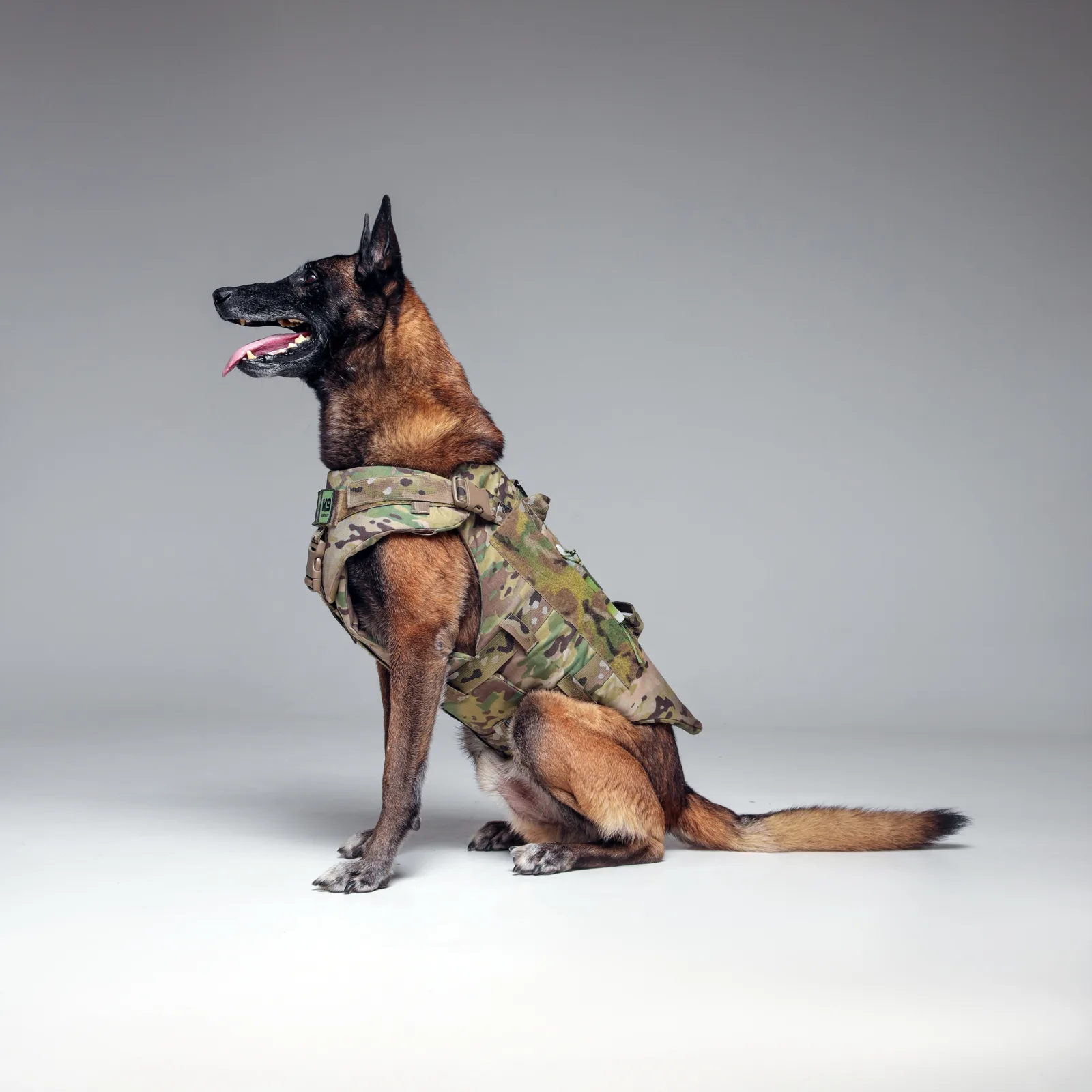
Tactical accessories for body armor: patches, handles, mounts
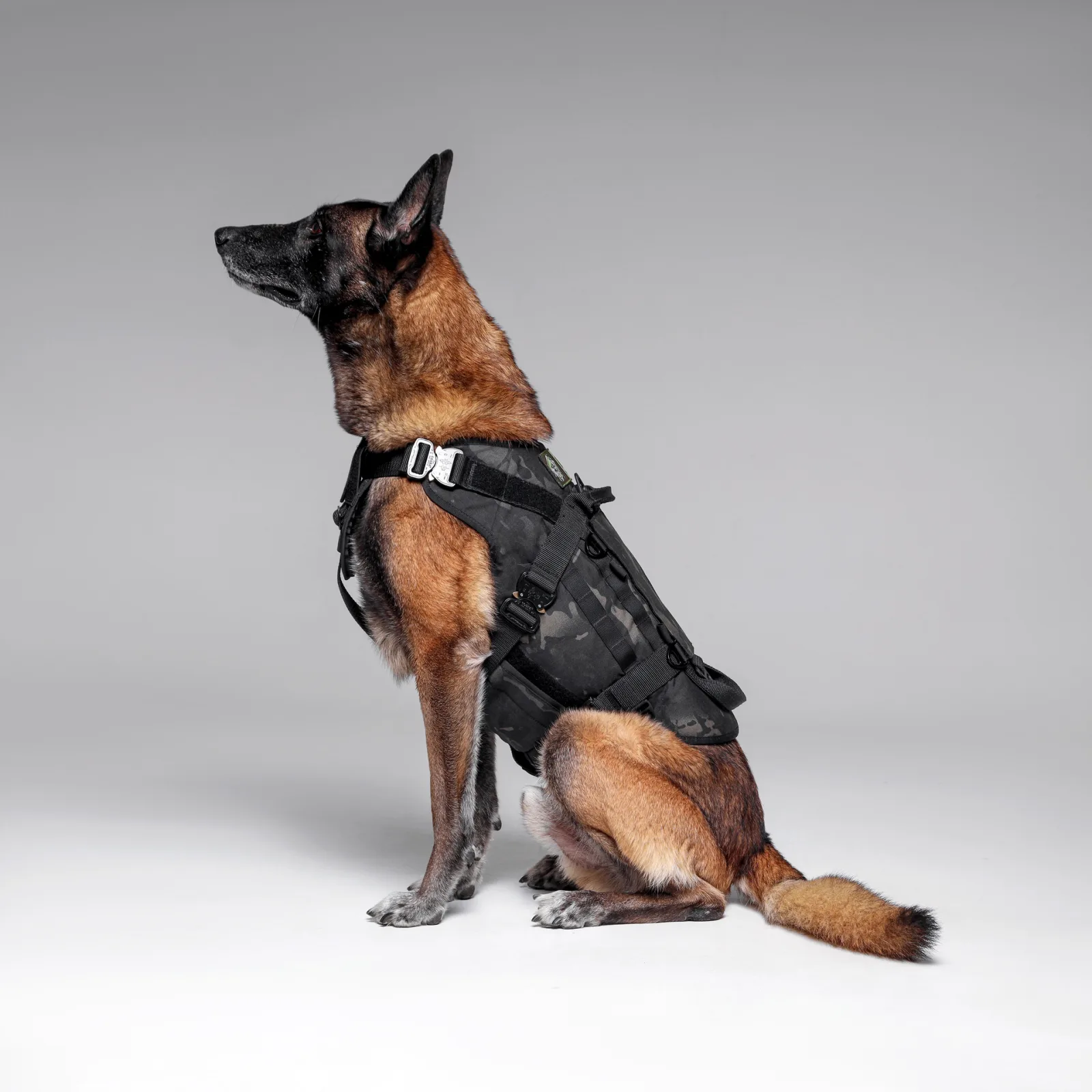
Tactical accessories turn body armor or a harness into a full working system: ID patches identify the dog and its medical specifics, a drag handle lets you quickly pull the animal out of danger, and MOLLE attachments add a GPS tracker, a flashlight and reflectors. The main rule is not to overload the gear: every element must genuinely serve the task. In Vartoviy K9 body armor and tactical harnesses everything needed for accessories is already provided: hook-and-loop for patches on the chest, two reinforced carry handles, D-rings and six rows of MOLLE on the sides. Below we cover the key accessories — ID patches, drag handles, GPS trackers, flashlights and reflectors — explain how to attach them correctly, which materials withstand field use, what not to add and how to build a balanced kit without excess weight.
ID patches: identification and medical information
Patches are the cheapest and at the same time the most important accessory. In a critical situation it's the patch that tells whose dog it is and how to help it. A standard set is 2–4 patches:
- The dog's name and the handler's or unit's contact phone — for return or evacuation.
- Unit and call sign — service identification.
- Blood type (DEA 1.1 +/−) — critical for veterinary care and transfusion.
- Allergies and medical specifics — reactions to medications and anesthesia.
Material matters. PVC patches and fabric ones with machine embroidery last for years and aren't afraid of moisture. Cheap options printed on fabric "paper" fade and crumble within 3–6 months. Attachment — by hook-and-loop (quick swap between tasks) or sewn-on (more reliable for permanent markings).
On Vartoviy K9 body armor and tactical harnesses, separate hook-and-loop on the chest panel and MOLLE fields are provided for patches, so extra attachments aren't needed — a patch is secured in seconds.
Drag handle: how to lift the dog safely
The drag (transport) handle is an element that saves lives. By it the handler grabs the dog to pull it out of fire, water or a dangerous area. In quality gear the handle is sewn in as standard and reinforced with a load-bearing strap.
The Vartoviy K9 body armor has two carry handles, and the tactical harness has a transport handle with Duraflex hardware and ITW Nexus half-rings rated up to 800 kgf. This is not a decorative element but a load-bearing node that withstands jerk loads.
If there's no handle, choose an accessory only with a load-bearing MOLLE attachment, not one sewn "on a single stitch." The correct placement is horizontally along the back, closer to the shoulder blades and the center of gravity: then the dog rises level, without tipping forward. Handles trimmed with neoprene don't slip in the hand in rain or with sweat. For carrying over a greater distance, a two-point lead works together with the handle, and in mountain or water conditions — leg-support straps.
GPS trackers: location control
A GPS tracker lets you find the dog if it breaks away from the handler. It's a separate device (our store doesn't sell it), but it has to be attached to the gear, so a few practical tips:
- For work outside mobile-network coverage (forest, field) radio-GPS systems are used; for the city and home control — trackers with a SIM card.
- In the field, battery life (preferably 24 hours+) and water protection of at least IP67 matter.
- The tracker is attached in a MOLLE pocket on the side of the gear — low and at the center of gravity. Don't hang it on the neck: during running this restricts breathing.
Six rows of MOLLE on the harness sides and MOLLE fields on the body armor provide enough room for a compact tracker pouch without upsetting the weight balance.
Flashlights: working in the dark
A compact flashlight on the gear is useful for night operations and search in low visibility. Guidelines for choosing:
- Weight — no more than ~80 g for a dog from 25 kg; a lighter animal needs a lighter flashlight.
- Mounting — a MOLLE loop angled 15–20° downward: the dog sees where it steps, and the light doesn't hit its eyes when it raises its head.
- Protection — the body must withstand impacts and moisture, with a fixed mode and no accidental switching.
Reflectors: visibility vs concealment
Reflective elements are an accessory "with character." On walks, patrol along roads and especially in search-and-rescue work they are mandatory: a 3M strip makes the dog visible at tens of meters. But on assault or reconnaissance tasks a glint gives the group away.
So the optimal solution is detachable hook-and-loop reflectors: before covert work they're removed, after — fixed back. In the Vartoviy K9 rescue harness the 3M reflective tape is integrated as standard (visibility up to 80 m), since for SAR tasks visibility is safety.
Cameras and other "trendy" accessories
A collar camera (body-cam) is a popular but narrowly specialized accessory: really needed only in specific documentation operations. If you install one, stick to the principle of minimal weight (roughly up to 60 g) and a reliable mount on the collar or upper gear node so the camera doesn't dangle during movement.
What NOT to attach to the dog
- "Tactical" knives, hammers, tomahawks — injury-prone when flipping over or falling.
- Pockets with ampoules and medications on the body — drugs should be carried by the handler in the tactical first-aid kit, not the dog.
- Large carabiners — get stuck in grilles, fences, hinder movement.
- Magnetized mounts — distort the operation of metal detectors and sapper equipment.
- Excess rigid elements in the belly area — press when lying down and crawling.
How to build a balanced kit
The main principle is "less is better." Every gram on the dog affects endurance and freedom of movement, so take only what will really be needed in your task. An approximate basic accessory set for a patrol dog:
| Accessory | Approx. weight | Mounting | When needed |
|---|---|---|---|
| ID patches (2–4 pcs) | up to 20 g | hook-and-loop / sewn-on | always |
| Drag handle | standard | load-bearing strap | always |
| GPS tracker in a pouch | 40–120 g | MOLLE on the side | open terrain |
| Flashlight | up to 80 g | MOLLE, 15–20° angle | night operations |
| Reflectors | up to 30 g | hook-and-loop (detachable) | SAR / roads |
Distribute the weight symmetrically relative to the spine and keep the center of gravity low and central — we wrote in detail about balance principles in the article on the MOLLE system and its use for K9. And to make all accessories last for years, follow the rules of caring for tactical gear.
FAQ
Which patches are mandatory for a service dog?
At minimum — name with a contact phone and blood type (DEA 1.1 +/−). It's advisable to add a note about allergies and medical specifics. Choose PVC or embroidered patches: printed-on-fabric ones fade within 3–6 months.
What load does the drag handle withstand?
A load-bearing handle should hold many times the dog's weight with a margin for a jerk. The Vartoviy K9 tactical harness uses Duraflex hardware and ITW Nexus half-rings with a test load up to 800 kgf, and the body armor has two reinforced carry handles.
Where is it best to attach a GPS tracker on the dog?
In a MOLLE pocket on the side of the gear, low and at the center of gravity. Don't hang it on the neck — that restricts breathing while running. For open terrain choose a tracker with 24 hours+ battery life and IP67 protection.
Can you attach a knife or multitool to the dog?
No. Rigid sharp objects are injury-prone when the dog flips over or falls. Tools and medications should be carried by the handler, in particular in the tactical first-aid kit.
Are reflectors needed on combat gear?
It depends on the task. For search-and-rescue and patrol along roads — yes; for covert operations — no, because a glint gives you away. The solution is detachable hook-and-loop reflectors that come off before work.
How many accessories can be loaded onto a dog?
As many as are really needed for the specific task, and no more. Every extra gram reduces endurance and freedom of movement. Distribute the weight symmetrically and keep the center of gravity low.
You can choose a base for accessories in the tactical gear and body armor categories. Have questions about the kit — call +38 (067) 465-68-64 or write via the contacts page.
This material was prepared by the Vartoviy K9 team — a Ukrainian maker of tactical and rescue gear for service dogs.