5 mistakes when buying a bulletproof vest for a dog
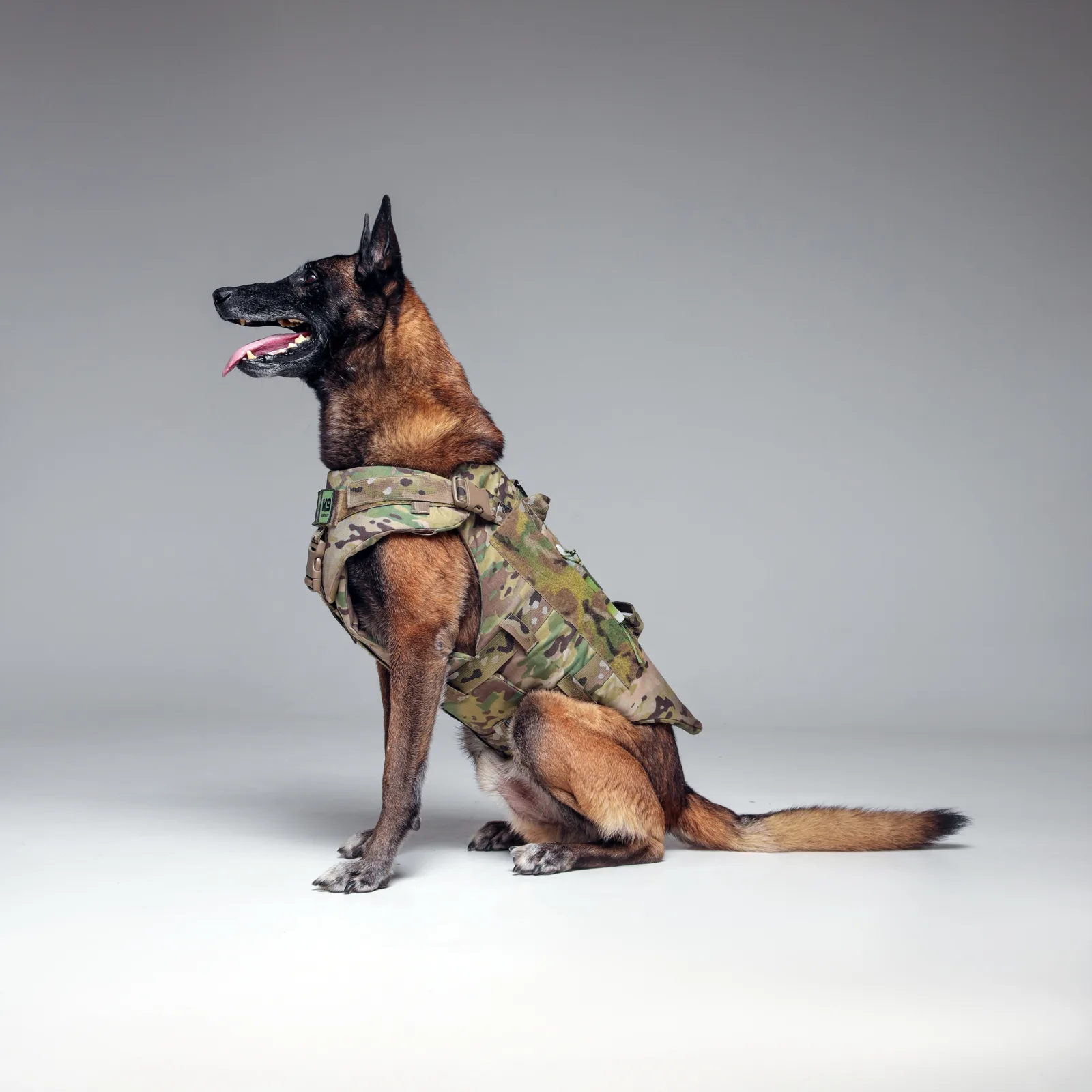
The five main mistakes when buying dog body armor are: buying "to grow into" instead of custom-fit tailoring, ignoring the product's weight, trusting fake certificates, choosing a bright color for combat work, and rejecting a model with replaceable ballistic panels. Vartoviy K9 body armor is sewn from ultra-high-molecular-weight polyethylene (UHMWPE) and certified to the Ukrainian standard DSTU 8782:2018 (Class 1): it stops 9×18 mm PM/APS and 9×19 mm Luger bullets and has anti-fragment protection to STANAG 2920. The single most important rule is this: the vest must be made exactly to your dog's body by individual measurements, not picked from a ready-made S/M/L chart. Below we break down each mistake in detail and explain how to do it right and save the animal's money and health.
Mistake #1: buying "to grow into"
Shepherd or Malinois puppies grow from 18 to 32 kg in a few months — that's a normal process. But body armor "to grow into," with a larger chest girth, will move around on the dog: the ballistic panel won't sit against the body, the center of gravity will shift, and protection becomes a formality. A dangling item also chafes and gets in the way of the dog's movement.
The right approach: before 14 months, don't buy a "combat" vest — limit yourself to a light tactical one to get used to the gear. After the skeleton has finished forming (usually 16–18 months), take measurements and order the main vest exactly to the body. Vartoviy K9 body armor is not sold in ready S/M/L sizes — each item is sewn for a specific dog to your measurements, so the "to grow into" problem disappears entirely. How to take measurements correctly is described in a separate article: how to measure a dog for body armor.
Mistake #2: ignoring the product's weight
The owner looks at the catalog, sees the protection class and the price — and isn't interested in the weight. Yet it's the weight that determines how long the dog can work effectively. A heavy vest (and some steel or ceramic solutions for people weigh 4–7 kg) turns a 28 kg dog into an animal carrying a quarter of its own weight and overheating within minutes.
The advantage of UHMWPE over steel and aramid is precisely the low weight at the same protection class. Fully kitted out, Vartoviy K9 body armor weighs only 2.4–2.8 kg depending on size and module set, because the ballistic panels are made of light ultra-high-molecular-weight polyethylene.
Vartoviy K9 body armor weighs only 2.4–2.8 kg even with extra pouches, so it stays comfortable for the dog and barely affects its mobility. More on thermal comfort and work duration — in the article how long a dog can wear body armor.
Mistake #3: believing in "NIJ certificates" from marketplaces
The most common scam is a cheap "body armor" with a "NIJ IIIA Certificate" sticker for a few thousand hryvnias, sewn from several layers of untested fabric without heat pressing. First let's understand the standard itself, so as not to confuse education with a fake.
What NIJ is. NIJ is the US ballistic-protection standard (National Institute of Justice). The NIJ IIIA class means protection against most pistol bullets, including powerful rounds. It's a real international standard, and knowing it is useful for comparison. But the NIJ class is assigned only to items that have passed official testing in an accredited lab under the NIJ Compliance Testing Program — an AliExpress sticker doesn't confirm that.
What standard our product meets. Vartoviy K9 body armor is certified not to NIJ but to the Ukrainian standard DSTU 8782:2018, protection Class 1. This means confirmed stopping of 9×18 mm PM/APS and 9×19 mm Luger bullets and anti-fragment protection by the STANAG 2920 method (the V50 figure). In other words, our body armor has real Ukrainian certification, not a marketing "NIJ IIIA" label.
How to vet a seller:
- ask which standard exactly the item is certified to (for Ukraine that's DSTU 8782:2018) and ask to see the document;
- clarify the ballistic panel material — in quality light vests it's UHMWPE, not a nameless "fabric";
- a suspiciously low price for "Class IIIA" is almost always a sign of a fake;
- if the seller promises an NIJ class but can't name the model number for verification in the official testing program — that's a red flag.
We've gathered a detailed comparison of ballistic standards here: DSTU vs NIJ — how to read a body-armor certificate.
Mistake #4: choosing color for aesthetics
Red, blue, neon green — these aren't for combat work. A service dog must not stand out against the background, neither by day nor at dusk. Working colors: coyote, olive, multicam, ranger green, black (for night tasks). Bright signal colors are appropriate for a completely different scenario — search and rescue, where the animal must instead be spotted quickly (there's a separate SAR-orange rescue harness for that).
The outer layer of Vartoviy K9 body armor is made of durable Cordura 500D fabric available in working colors. If the dog takes part in demonstration outings and parades — get a separate "parade" item and don't mix functions. How to choose between a camouflage and a signal color we break down here: camouflage vs signal color.
Mistake #5: buying a vest with no panel replacement
After a bullet hit or a strong impact, the ballistic panel partially loses its properties — that's normal, since it absorbed the energy. If the vest is a single monoblock, after the very first serious hit you throw away the whole item. Quality models instead have separate panel pouches with a quick-release fastener.
Vartoviy K9 body armor has a modular design: separate protective modules for chest, back with sides and belly, plus an optional removable neck module. The panel in its pouch can be replaced without buying a new vest. Exactly how this is done and when the panel needs changing is described in the article replacing body-armor ballistic panels.
Bonus: the mistake of choosing size "by chart"
Many catalogs offer a ready size "M" for dogs of 25–32 kg. This is a crude and dangerous oversimplification: two shepherds weighing 28 kg can have chest girths differing by 15 cm. Going by weight alone means getting a vest that sits crooked.
The right way is three measurements: chest girth, neck girth and back length. It's by these parameters that Vartoviy K9 sews body armor individually. If a maker doesn't ask for measurements and offers only an S–L chart — that's a suspicious sign. For small breeds there are separate fit nuances, about them here: body armor for small dog breeds.
In short: a checklist for the right purchase
- order by individual measurements, not by a size chart;
- check the product's weight — ours is 2.4–2.8 kg thanks to UHMWPE;
- demand a real certificate (for Ukraine — DSTU 8782:2018), not an "NIJ" sticker;
- choose a working color for the task, and a signal one only for rescue work;
- take a modular design with replaceable panels.
Ready to pick gear correctly? See Vartoviy K9 body armor or the whole ballistic protection section. Delivery across Ukraine is free by Nova Poshta with dispatch within one business day — terms on the delivery page.
FAQ
Does Vartoviy K9 body armor have an NIJ IIIA certificate?
No. Our body armor is certified to the Ukrainian standard DSTU 8782:2018 (protection Class 1) and stops 9×18 mm PM/APS and 9×19 mm Luger bullets. NIJ IIIA is a separate US standard; we cite it only for comparison and don't attribute it to our product. Details — in the article on DSTU and NIJ ballistic standards.
What material is the ballistic panel made of?
Of ultra-high-molecular-weight polyethylene (UHMWPE) — a modern fiber lighter than steel and aramid at the same protection class. It's thanks to it that the full item weighs only 2.4–2.8 kg. The outer layer is hard-wearing Cordura 500D fabric.
How much does the body armor weigh and won't it be too heavy for the dog?
The full kit weighs 2.4–2.8 kg depending on size and module set. This is safe even for medium-weight dogs — the vest barely restricts mobility and doesn't overheat the animal. Also see the article on wear duration.
How do I take measurements correctly if the vest is custom-made?
Three main measurements are needed: chest girth behind the front legs, neck girth and back length. A step-by-step guide with photos — in the article how to measure a dog for body armor.
Can the panel be replaced after a hit without buying a new vest?
Yes. The design is modular, the ballistic panels are in removable pouches, so after a hit only the panel is changed, not the whole item. How to do it — in the article on replacing ballistic panels.
What is the warranty on the body armor?
12 months on the product and 3 years on the ballistic panel. Full terms — on the warranty page.