Can a dog wear a bulletproof vest all day?
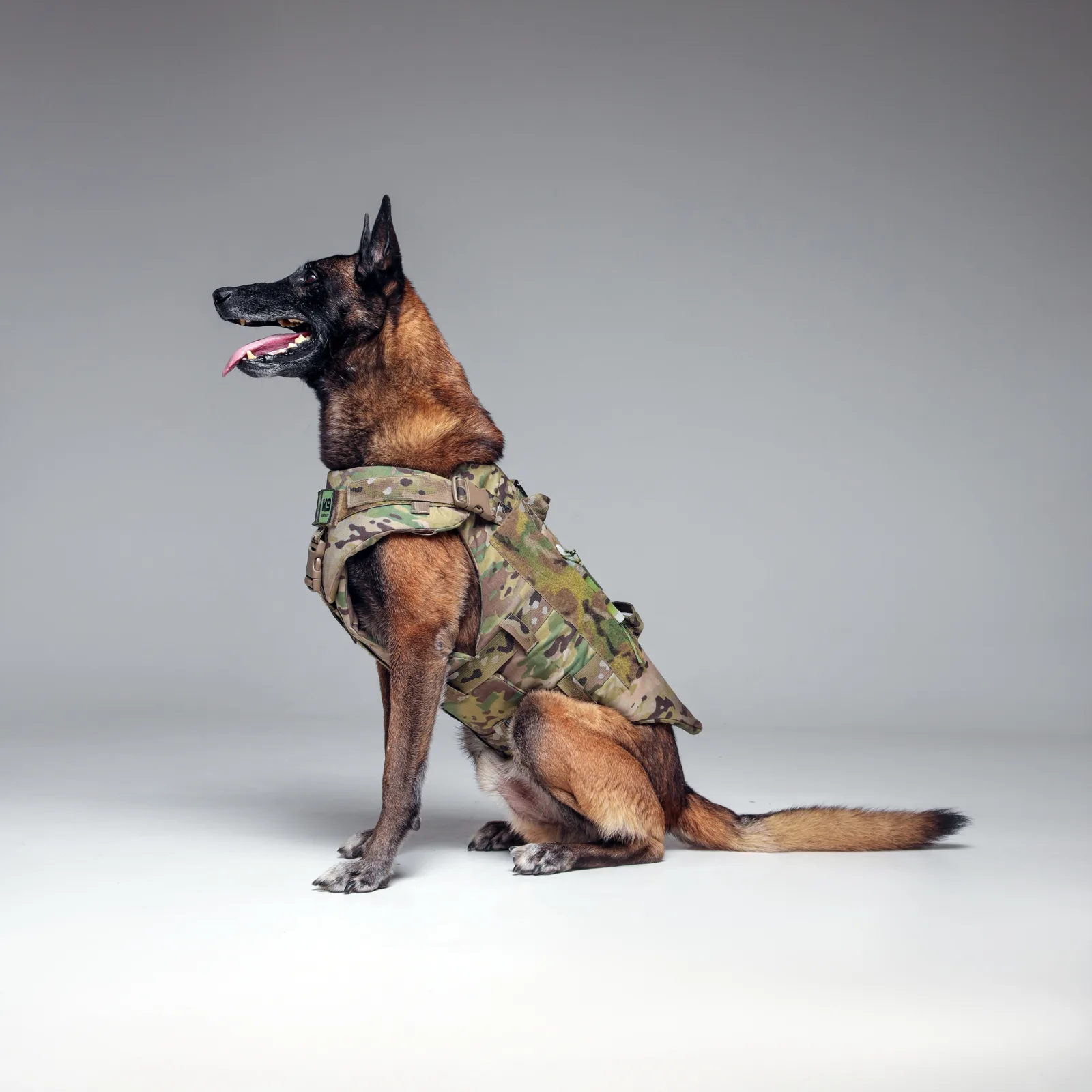
A healthy service dog can work in body armor for 2–4 hours in cool weather (up to +20 °C) and only 30–60 minutes in the heat (above +25 °C), but "all day" without breaks — no. Body armor covers a significant part of the torso and hinders heat dissipation, so the main limiter is not the product's weight but the risk of overheating. The right gear choice helps ease the task: Vartoviy K9 body armor weighs only 2.4–2.8 kg (UHMWPE ballistic panel to DSTU 8782:2018, Class 1), is sewn to your dog's size by measurements and has a modular design, so excess protection is easy to remove. Below we cover the physiology of overheating, real wear limits by temperature, the first signs of heatstroke, a 4–6 week adaptation program and a simple field test before work. These rules are the same for patrol, search and training dogs — in gear without ballistics (a tactical vest) the limits are wider, but temperature control is always needed.
Why body armor is a load for the dog
A dog cools mainly through breathing (tongue and mouth) and partly through the sweat glands in the paw pads. The skin under the coat barely produces sweat like a human's, so "ventilation" of the body is limited. Body armor covers about 35–50% of the torso surface and creates an extra layer that retains heat — that, not weight, is the main risk factor.
Weight matters too, but here it's important not to confuse gear for dogs with body armor for people. Vartoviy K9 body armor weighs 2.4–2.8 kg thanks to a ballistic panel of ultra-high-molecular-weight polyethylene (UHMWPE) — much lighter than metal or ceramic solutions. The product is certified to DSTU 8782:2018 (Class 1) and stops 9×18 mm PM/APS and 9×19 mm Luger bullets, and also has anti-fragment protection to STANAG 2920.
An approximate example: at +25 °C and active work, the dog's body temperature in body armor can rise by 1–2 °C per hour. A shepherd's normal rectal temperature is 38.3–39.2 °C. A reading of 40 °C and above is already the heatstroke zone, at which work must be stopped immediately.
How long it can be worn: limits by temperature
There is no universal "can be worn all day" — the time depends on air temperature, the dog's fitness and the intensity of the load. Below are approximate limits for a healthy adult dog in Class 1 body armor to DSTU 8782:2018 (product weight 2.4–2.8 kg). These are working recommendations, not "permission" to ignore the animal's condition: any sign of overheating cancels the table.
| Air temperature | Max continuously | Breaks |
|---|---|---|
| up to +15 °C | up to 3–4 hours | 15 min every hour |
| +15…+20 °C | up to 2 hours | 15 min every 45 min |
| +20…+25 °C | up to 60–90 min | 10 min every 30 min |
| +25…+28 °C | up to 30–45 min | shade + water every 20 min |
| above +28 °C | avoid; only brief actions up to 15 min | constant monitoring |
For training and patrol without ballistic protection the limits are wider — in that case it's better to take a tactical vest without a panel, which weighs less and ventilates better. Body armor with a panel is sensible to wear only where ballistic protection is really needed.
How weight and design affect duration
Lower weight and a thoughtful design directly extend the dog's working time. What to look at:
- Panel material. UHMWPE is lighter than aramid and metal-ceramic at the same protection class, so the load on the spine and muscles is lower.
- Modularity. Vartoviy K9 body armor consists of modules (chest / back+sides / belly, optional removable neck module) — extra sections can be removed to lighten the product for a specific task.
- Custom fit. The product is sewn to your dog's measurements, not from a ready S/M/L range. A precise fit doesn't press, chafe or cover excess body area.
- Outer layer. Cordura 500D is strong enough and at the same time lighter than the denser 1000D — less excess weight without losing abrasion resistance.
Before ordering the product, it's worth taking measurements correctly — covered in detail in the article how to measure a dog for body armor. A sizing error is the most common reason a dog tires quickly in the gear.
Signs of overheating: when to remove the vest immediately
The dog's condition must be monitored continuously, not "when you notice." The first signals of overheating:
- Frequent shallow breathing — over 100 breaths/min at relative rest.
- A strongly extended tongue, viscous or bubbly foam at the mouth.
- A confused gaze, loss of concentration, ignoring familiar commands.
- Stumbling, an unsteady gait, loss of coordination.
- A change in gum color (too pale or, conversely, bright red); after pressing with a finger, the white spot doesn't disappear within 2 seconds.
At any of these symptoms act immediately: remove the body armor, move the dog into the shade, cool the paws and belly with cool (not icy) water, give water in small portions. In severe cases — urgent veterinary transport. To evacuate the dog from the field, a rescue harness with a lifting handle will come in handy.
A 4–6 week adaptation program
You can't immediately put a dog in body armor for several hours — endurance is built up gradually. An approximate plan:
- Week 1: light vest without a ballistic panel, 15 min a day, calm walking.
- Week 2: vest with a panel, 30 min, moderate pace.
- Week 3: 1 hour with simple working exercises.
- Weeks 4–5: 90 minutes with full exercises.
- Week 6: reaching working endurance — 2–3 hours in cool weather with breaks.
Start the adaptation in cool weather and increase the load only when the dog feels confident at the previous stage. Gear care also affects comfort: dirty or "stiffened" fabric ventilates worse — how to keep the product in shape, see in the guide caring for body armor: washing and storage.
Ventilation and a field test before work
An internal breathable lining with an air-gap effect helps improve heat dissipation — Vartoviy K9 tactical gear (for example, the tactical harness) uses a 3D Mesh + EVA lining that keeps the body at a small distance from the fabric and improves air circulation. In the heat this adds working time.
A simple test before a serious task: put the gear on the dog and walk it at a calm pace for 10 minutes, then measure the rectal temperature.
- Rose by 0.5 °C — that's normal, you can work within the table above.
- Rose by 1.0 °C or more — cut the planned working time at least in half and tighten monitoring.
FAQ
Can a dog wear body armor all day long?
No. Even in cool weather continuous wear is limited to 3–4 hours with breaks, and in the heat — to 30–60 minutes. Body armor hinders heat dissipation, so "all day" without removal creates a risk of overheating. Put it on only for the time when ballistic protection is really needed.
How much does Vartoviy K9 body armor weigh?
2.4–2.8 kg depending on size and module set. This weight is achieved thanks to the UHMWPE ballistic panel to DSTU 8782:2018 (Class 1). The modular design lets you remove extra sections and lighten the product for a specific task.
What protection class does this body armor have and is it NIJ IIIA?
Vartoviy K9 body armor is certified to the Ukrainian standard DSTU 8782:2018, Class 1, not to the US NIJ. NIJ is a foreign classification system (where, for example, NIJ IIIA is rated for pistol bullets) often cited for comparison. Our product is tested specifically to DSTU and stops 9×18 mm PM/APS and 9×19 mm Luger bullets. More on the differences between standards — in the article on DSTU and NIJ ballistic standards.
How do I tell the dog is overheating in body armor?
The first signs are frequent shallow breathing (over 100 breaths/min), a strongly extended tongue with foam, loss of concentration, an unsteady gait and a change in gum color. At any symptom, immediately remove the vest, move the dog into the shade, cool the paws and belly with water and give it small portions to drink.
Is a tactical vest better for long shifts?
Yes, if ballistic protection isn't needed. The tactical vest is built on the body-armor platform but without the heavy panel, so it's lighter and ventilates better — for training, patrol and carrying gear it allows longer shifts. A comparison of the two products is in the article body armor vs tactical vest.
Where to buy a light, custom-fit body armor for a dog?
In the Protection category on the Vartoviy K9 site. The product is sewn to your dog's measurements (not from a ready size range), weighs 2.4–2.8 kg and has a 12-month warranty on the product and 3 years on the ballistic panel. Delivery across Ukraine is free by Nova Poshta.
This material was prepared by the Vartoviy K9 team — a Ukrainian maker of tactical and ballistic gear for service dogs (FOP Slavinska Tetiana Yuriivna, Kyiv). Sizing consultation: +38 (067) 465-68-64.