Body armor vs tactical vest: 7 key differences
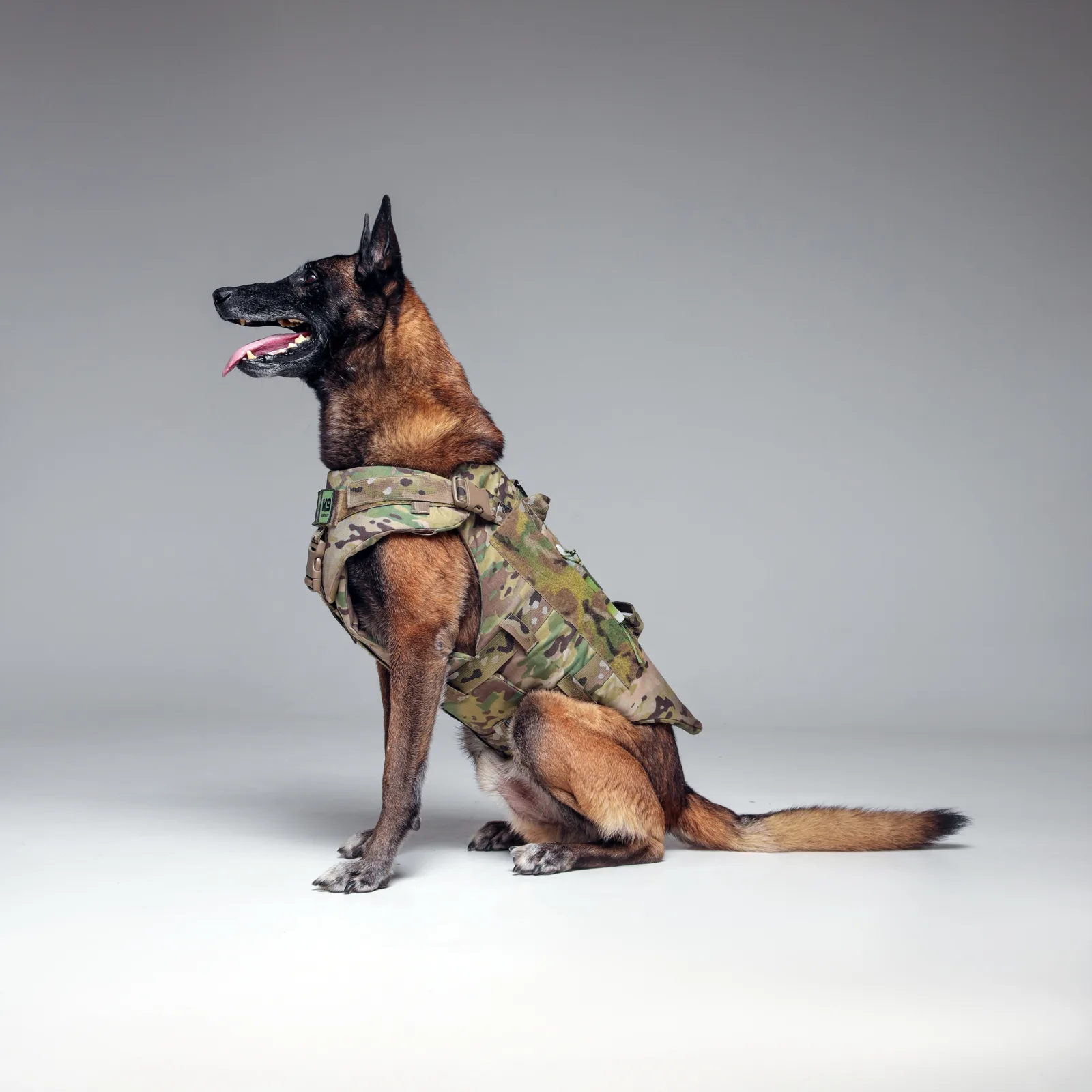
Body armor and a tactical vest for a service dog are different gear with different jobs. The Vartoviy K9 body armor is ballistic protection: a panel of ultra-high-molecular-weight polyethylene (UHMWPE) certified to DSTU 8782:2018, protection class 1. It stops 9×18 mm PM/APS and 9×19 mm Luger pistol bullets and resists fragments (tested per STANAG 2920, V50 rating). The tactical vest is the same comfortable gear carrier built on the armor platform, but WITHOUT the ballistic panel: it protects the dog from scratches against rebar and branches, lets you attach pouches to MOLLE and work with evacuation straps, but it does not stop a bullet. In short: take the body armor when there is a risk of fire contact; the tactical vest — for training, patrol and carrying gear. Below we break down the seven key differences.
In brief: the main difference
Both items look similar — the same Cordura 500D base, the same MOLLE webbing, a carrying handle. The difference is inside: the body armor has a ballistic panel, the tactical vest does not. Everything else — weight, price, use case, care — follows from exactly that.
| Parameter | Vartoviy K9 body armor | Tactical vest |
|---|---|---|
| Ballistic panel | Yes, UHMWPE per DSTU 8782:2018 (Class 1) | None |
| What it stops | 9×18 PM/APS, 9×19 Luger bullets; fragments (STANAG 2920) | Scratches, abrasion, branches |
| Weight | 2.4–2.8 kg | Noticeably lighter (no panel) |
| Outer fabric | Cordura 500D | Cordura |
| Attachments | Side MOLLE, 2 handles, D-rings | MOLLE, compatible with evacuation straps |
| Scenario | Risk of fire, assault, combat tasks | Training, patrol, gear carrying |
| Warranty | 12 months on the item + 3 years on the ballistic panel | 12 months on the product |
1. Protection: bullet and fragments vs. abrasion and scratches
The main difference is the threat level the item protects against. The Vartoviy K9 body armor contains a ballistic panel of ultra-high-molecular-weight polyethylene (UHMWPE). It is a modern fiber material, lighter than older-generation aramid fabrics. The panel is certified to DSTU 8782:2018, Class 1 — the Ukrainian ballistic protection standard. Under this class, the item stops 9×18 mm PM and APS and 9×19 mm Luger pistol bullets and resists shrapnel and fragments (resistance is tested per the STANAG 2920 method with V50 determination).
The tactical vest has no ballistic panel. Its purpose is to let the dog work comfortably: protect the skin from scratches against rebar, concrete and bushes, distribute pouch weight evenly and provide attachment points. It does not stop bullets and is not designed to.
It is important to understand the limits of protection: the body armor is rated for pistol rounds and fragments per DSTU Class 1, not for rifle bullets. That is a deliberate weight-to-protection balance for a dog that has to stay mobile.
2. Weight: why it is critical for a dog specifically
For a person, an extra kilogram of gear is discomfort. For a dog, the armor's weight directly affects endurance, heat exchange and speed. The Vartoviy K9 body armor weighs 2.4–2.8 kg depending on size and module configuration — a deliberately lightened design thanks to the UHMWPE panel instead of heavier materials.
The tactical vest is lighter because it has no ballistic panel — only the fabric base with attachments remains. That is why, for long training sessions, patrols and hot weather, many handlers choose the tactical vest, and put the armor on selectively — for a specific task with a risk of fire. We covered how long a dog can work continuously in protection in the article on body armor wearing time.
3. Design and fit: made to measure vs. a size chart
Here lies the fundamental difference of our approach. The Vartoviy K9 body armor is not an off-the-shelf S/M/L, but an item sewn for a specific dog from taken measurements. That way the ballistic panel fits snugly, does not shift while running, does not chafe and leaves no unprotected zones. How to take measurements correctly is shown in detail in the guide how to measure a dog for body armor.
The armor is modular: separate chest, back with sides, abdomen, and an optional removable neck protection module. On the sides there are MOLLE straps, two carrying handles, D-rings for attachments and Velcro for patches/insignia. The tactical vest inherits the same ergonomics and MOLLE, so gear and pouches move between the items with no rework. For how to lay out gear efficiently on the webbing, read the guide on the MOLLE system.
4. Price: what you pay for
The tactical vest is cheaper because it is mostly fabric, hardware and sewing work. The body armor costs more because of the UHMWPE ballistic panel, DSTU 8782:2018 certification and individual tailoring for the dog. It is not a "vest with metal sewn in", but an engineered product with guaranteed characteristics.
See current prices for specific models in the catalog: the "Protection" category (body armor) and the "Tactical gear" category. The Vartoviy K9 body armor is protected by a Ukrainian patent — you pay for an original Ukrainian design, not a nameless copy.
5. Use case
- Tactical vest: daily training, patrolling, search-and-rescue outings, demonstrations, carrying gear and pouches, working with evacuation straps.
- Body armor: tasks with a real risk of fire contact — assault actions, room clearing, work in a combat zone where pistol rounds and fragments are a possible threat.
In practice many units have both items: the tactical vest "for every day" and the body armor "for the threat". Since they are built on a shared platform, switching between them is familiar to the dog.
6. Care and washing
The tactical vest is undemanding: the fabric base can be gently hand-washed at a low temperature with a mild detergent and dried in the shade. The body armor needs more careful handling: the fabric shell is removed and cleaned separately, and the ballistic panel must not be washed, soaked, or dried in direct sun or near heaters — that preserves its characteristics for its entire service life. We collected the step-by-step routine in the article body armor care: washing and storage.
7. Warranty and service life
Here it is important to distinguish the manufacturer's warranty from the actual service life. Both Vartoviy K9 items come with a 12-month warranty on seams and hardware. In addition, the armor's ballistic panel carries a 3-year warranty. A tactical vest, with proper care, lasts years of active use.
All the terms — warranty replacement, what counts as a warranty case — are described on the warranty page. If the panel needs renewing, that is done separately: see the guide on replacing ballistic panels.
What about "NIJ IIIA"? A few words on standards
Descriptions of foreign gear often carry the NIJ marking (NIJ Level II, IIIA, etc.) — the American ballistic protection standard of the US National Institute of Justice. It is a recognized standard that allows comparing protection levels worldwide: NIJ Level IIIA, for example, covers a wide range of pistol rounds.
However, the Vartoviy K9 body armor is certified not to NIJ but to the Ukrainian standard DSTU 8782:2018 (Class 1). That means its protective characteristics are confirmed by the national test methodology and correspond to 9×18 PM/APS and 9×19 Luger rounds. So the correct wording is "DSTU 8782:2018, Class 1" — attributing an NIJ class to the product would be wrong. If you want to dig deeper into ballistic standards and how they map to each other, we dedicated a separate article to it — on the DSTU and NIJ ballistic standards.
What to buy first?
If you are only assembling your gear — start with the tactical vest. It covers most everyday scenarios: training, patrol, search-and-rescue outings, carrying pouches. The body armor is added later — for specific tasks with a risk of fire contact. Before buying armor it is useful to read the 2026 body armor buyer's guide and the breakdown of typical buying mistakes.
And the main safety rule: never use a tactical vest with makeshift metal inserts as a "budget body armor". It will not stop a bullet — on the contrary, if penetrated, metal produces secondary fragments. Ballistic protection must be a certified product, not an improvisation.
Frequently asked questions
Does the tactical vest stop a bullet?
No. The tactical vest has no ballistic panel and is not rated to stop bullets. It protects the dog from scratches, abrasion and mechanical damage and serves as a gear carrier. For protection from gunfire you need body armor with a DSTU 8782:2018 panel.
What protection class does the Vartoviy K9 body armor have?
The armor is certified to the Ukrainian standard DSTU 8782:2018, protection class 1. It stops 9×18 mm PM/APS and 9×19 mm Luger bullets and resists fragments (tested per STANAG 2920). It is a Ukrainian product, not a foreign NIJ-rated model.
How much does dog body armor weigh?
The Vartoviy K9 body armor weighs 2.4–2.8 kg depending on size and module set. That weight is achieved thanks to the UHMWPE panel. The tactical vest is lighter because it has no ballistic panel.
Is the armor made to measure, or are there ready sizes?
The Vartoviy K9 body armor is sewn individually for your dog from taken measurements, not sold as ready S/M/L. That ensures a snug panel fit and no unprotected zones. A measuring guide is available on our blog.
What should I buy first — a tactical vest or body armor?
For most owners it is logical to start with the tactical vest: it covers daily tasks (training, patrol, carrying gear). Body armor is added for tasks with a risk of fire. Since both items share the MOLLE platform, gear moves easily between them.
What is the warranty on these items?
Both items carry a 12-month warranty on the product. The armor's ballistic panel additionally carries a 3-year warranty. The terms are described on the warranty page.
Prepared by the Vartoviy K9 team — a Ukrainian manufacturer of tactical and rescue gear for service dogs. Questions about choosing between body armor and a tactical vest? Call +38 (067) 465-68-64 or write to us via the contact page.